
Case study · Dargavel Village, Bishopton
Front garden hard landscaping in Dargavel, Bishopton
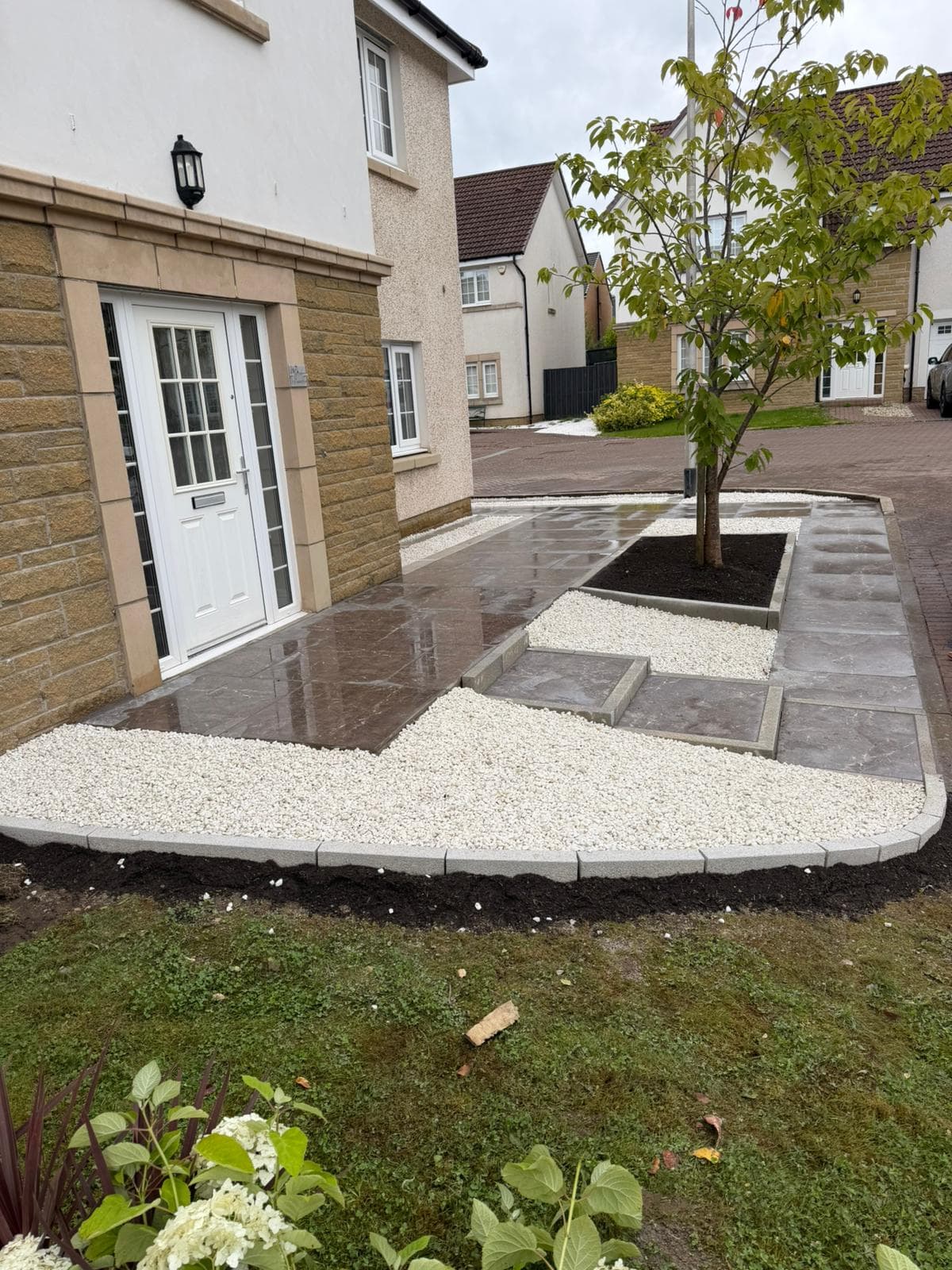
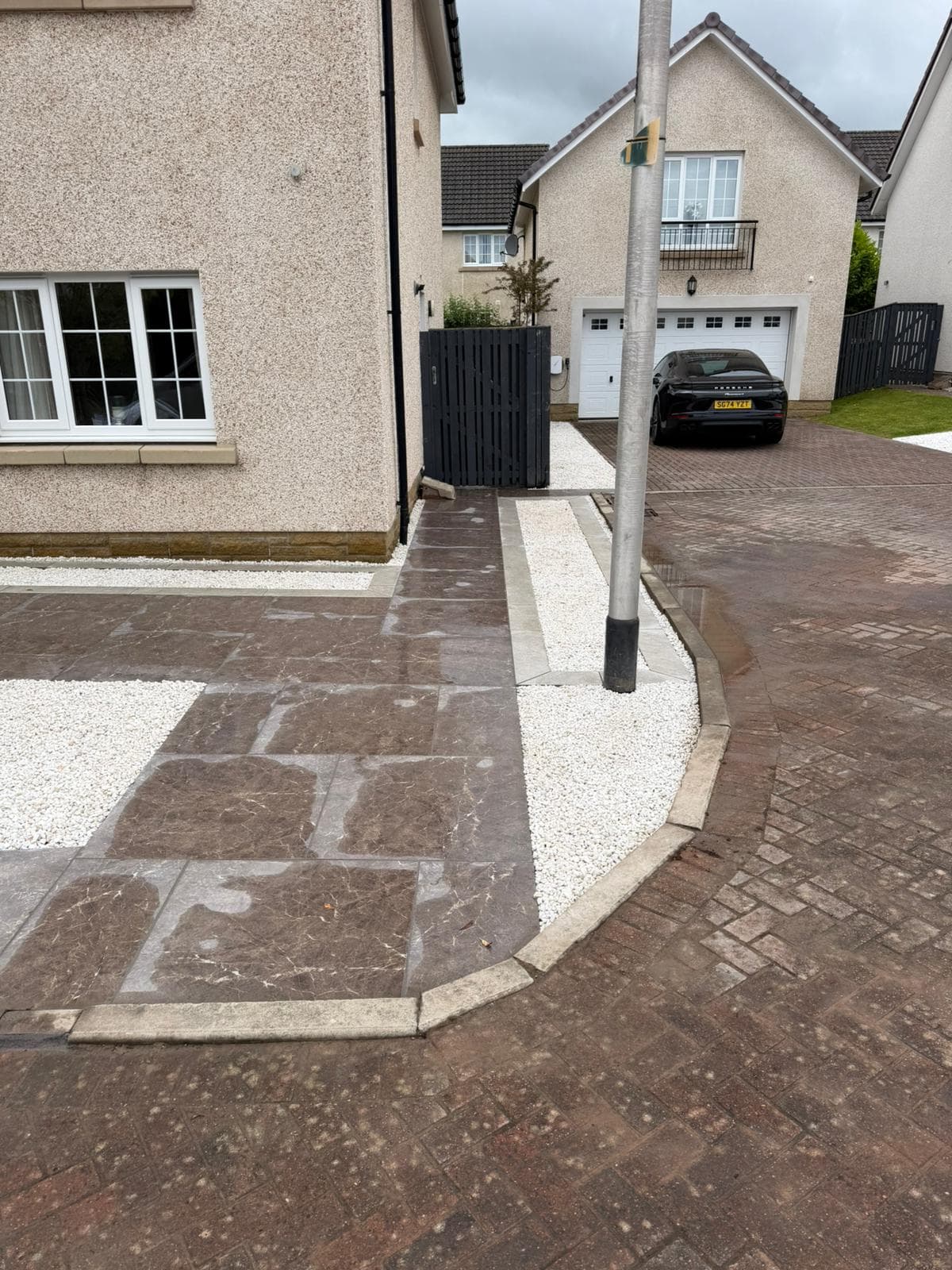
A new-build frontage left as bare ground by the developer, rebuilt with porcelain paving, granite kerbing and white gravel panels around the existing tree.
Dargavel Village, Bishopton
Front garden hard landscaping
A new-build frontage left as bare ground by the developer, rebuilt with porcelain paving, granite kerbing and white gravel panels around the existing tree.
Read the case studyAt a glance
The job in short
- Location
- Dargavel Village, Bishopton
- Work
- Front garden hard landscaping
- Surface
- Marble-effect porcelain with buff banding
- Edging
- Silver granite kerb setts on concrete
- Infill
- White decorative gravel over membrane
- Kept
- The existing ornamental cherry
What the developer left behind
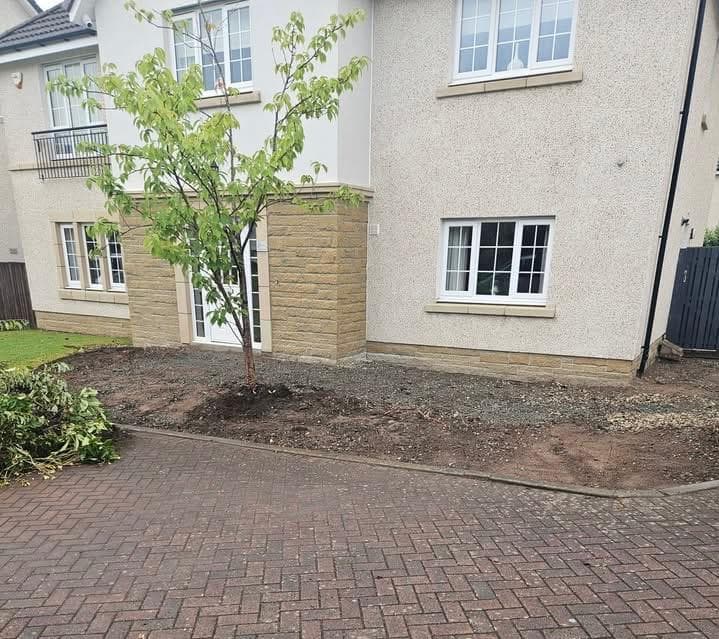
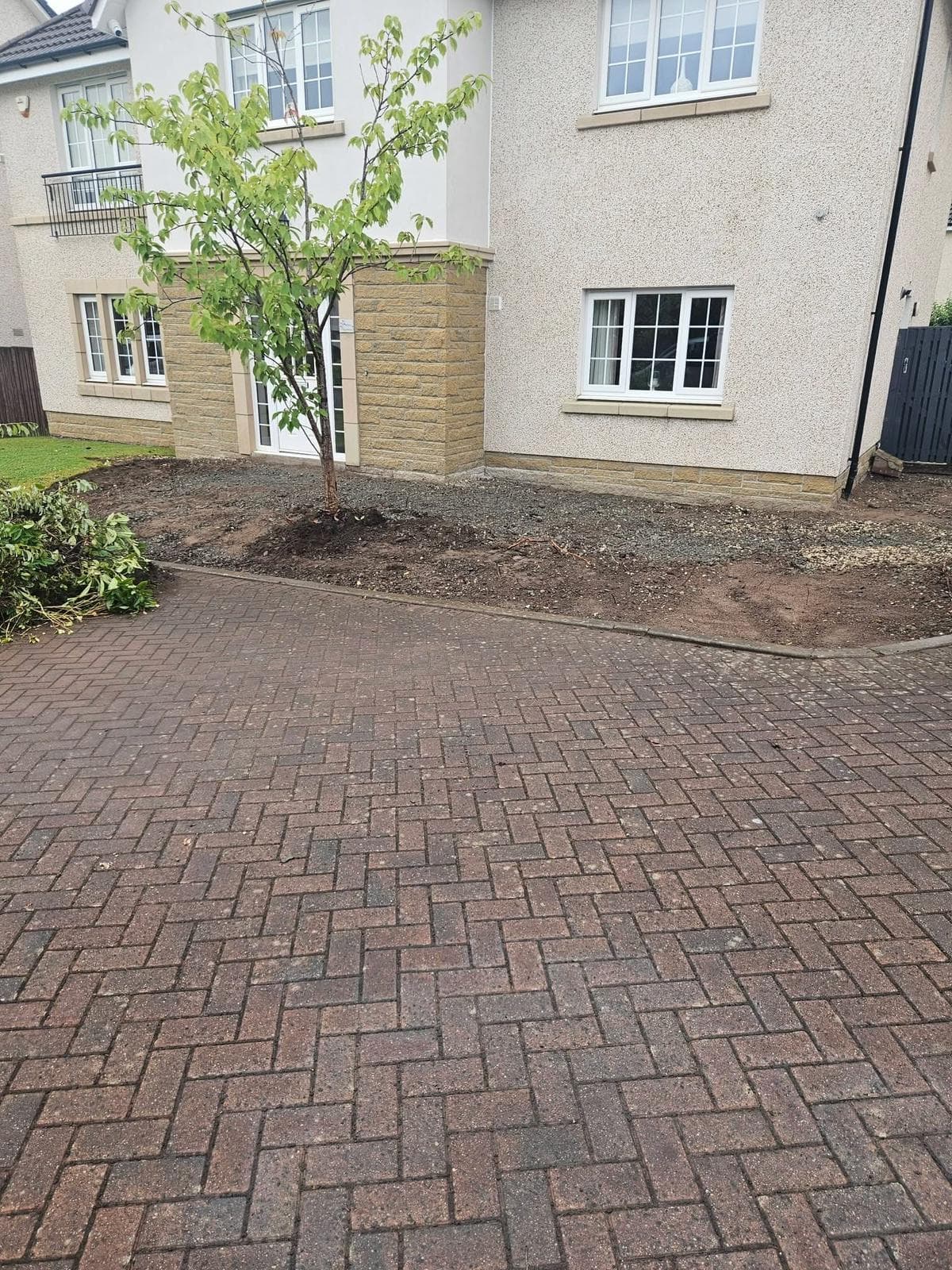
Dargavel Village is a large modern development on the west side of Bishopton, and its front gardens share a very particular problem. The house is finished to a high standard, the monoblock driveway is down, and then the strip between the two is handed over as bare ground with a single young tree planted in it.
On this plot that strip ran the full width of the frontage and round the gable towards the side gate. The before photographs show what it amounted to: compacted subsoil with builder's stone mixed through it, a loose rubble margin along the base of the wall, a young ornamental cherry sitting in the middle of it, and no edge at all where the ground met the monoblock. Without an edge, soil and stone wash onto the driveway every time it rains, which in Renfrewshire is frequently.
It is a frontage rather than a garden. Nobody sits in it. What it has to do is look finished, deal with water sensibly, and stay that way without weekly attention, and bare ground does none of those things.
What was agreed on site
The brief was straightforward: no lawn to cut at the front, no bare soil, and a proper front door approach that works in the rain. The existing monoblock driveway was sound and staying, so everything new had to sit against it convincingly rather than competing with it.
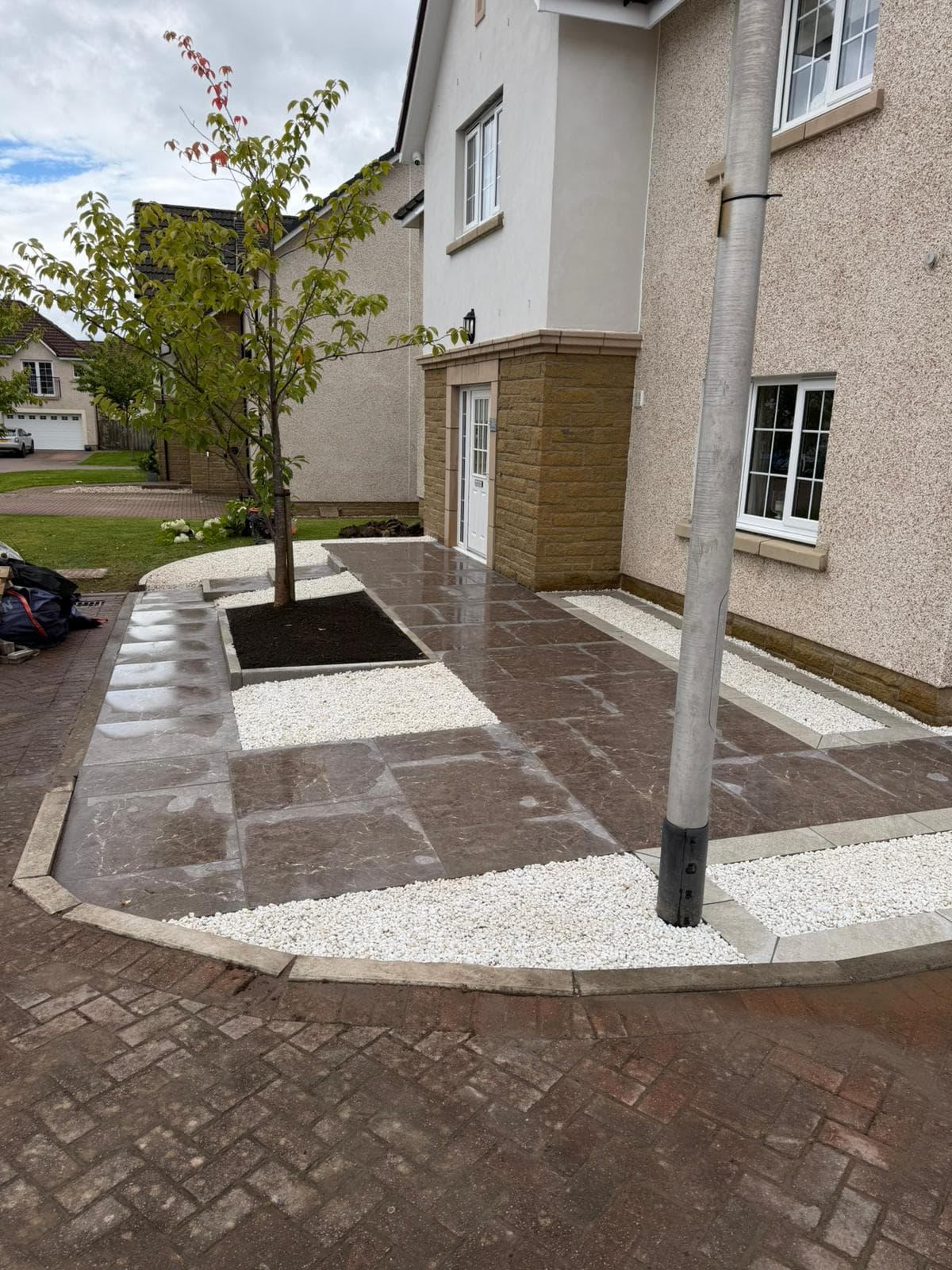
The design that came out of that is a porcelain surface running from the front door and wrapping round the gable to the side gate, with panels of white decorative gravel breaking it up, a granite kerb holding the whole thing against the driveway, and the cherry tree kept where it stands in its own square bed. The gravel does the work that planting would otherwise do visually, without becoming something that needs weeding and cutting back.
Keeping the tree was a deliberate decision rather than an obvious one. It was already established, it gives the frontage its only height, and a bed cut around it is far better value than replacing it with something smaller.
Building it
The bare ground was dug out to a depth that allowed a proper compacted sub-base under the paved areas. Front gardens on new developments are often built over ground that has had site traffic across it, and the temptation is to lay straight onto what is there. Porcelain laid on a poor base will telegraph every soft spot within a year, so the base is where the time goes.
The granite kerb setts went in next, bedded on concrete and haunched behind. The kerb line is the thing that makes or breaks a frontage like this: it is what you actually see from the street, it holds the gravel in, and it stops the whole build spilling onto the monoblock. Running it as a curve to meet the driveway, then turning it through the angles at the corner of the plot, takes considerably longer than a straight line and is the reason the finished edge reads as deliberate.
The porcelain was laid on a full mortar bed with each slab primed on the back, which is how porcelain has to be laid. It is a dense, non-porous material and it will not bond to mortar on its own. Falls were set to run water away from the house wall rather than towards it. A lighter buff porcelain was used as a banding course through the darker marble-effect field, which breaks up what would otherwise be a large single-tone area and picks up the sandstone detailing on the house.
White decorative gravel went into the remaining panels over a weed membrane, kept down below the top of the kerb so it stays where it is put. A gravel margin was left along the foot of the wall, which keeps rain splash off the render and gives access to the downpipe. The lamp column and the rainwater downpipe were both cut around rather than paved up to, which is the sort of detail that is invisible when it is done properly and obvious when it is not.
Topsoil was reinstated behind the kerb where the new work meets the lawn, so there is a clean transition rather than a raw edge.
How it performs
The frontage now has no maintenance requirement worth the name. There is nothing to cut, the gravel is over membrane and held by a kerb, and porcelain does not stain, host moss the way concrete slabs do, or need sealing. A brush and an occasional wash down is the whole of it.
The practical gain is the front door approach. The route from the driveway to the door is now a paved surface with falls on it rather than compacted mud, which matters most on exactly the days it is least pleasant to think about.
The tree keeps its bed and has room to put on growth, and the square of dark soil around it gives the frontage a focal point that the paving and gravel on their own would not have.
Materials used
- Marble-effect porcelain paving, full mortar bed and primed backs
- Buff porcelain banding course
- Silver granite kerb setts, bedded and haunched on concrete
- White decorative gravel over weed membrane
- Compacted MOT sub-base under all paved areas
- Topsoil to reinstate the lawn edge
Photographs from the job
Questions about work like this
Why porcelain rather than concrete slabs for a front garden?
Porcelain is non-porous, so it does not absorb water, does not stain from leaf litter or oil, and does not build up the green film that concrete slabs get in a damp Scottish winter. It costs more to buy and takes longer to lay, because it needs a full mortar bed and priming on the back of each slab, but on a frontage that is seen from the street every day it holds its appearance far longer.
Will white gravel stay white?
It dulls slightly over the first year and then holds. Laying it over a membrane, keeping it below the top of the kerb so it is not being walked out onto the driveway, and giving it a rinse occasionally keeps it looking close to new. Gravel that is laid straight onto soil without a membrane goes grey quickly because the soil comes up through it.
Can you do this on a new-build front garden that the developer left as soil?
Yes, and it is common work across Dargavel and the other new developments in the area. The main thing to check is the ground, because site traffic during construction leaves it compacted and mixed with stone, which affects how much has to be dug out before anything can be laid.
Does the existing driveway need to be lifted?
Usually not. On this job the monoblock was sound and stayed exactly as it was, with the new granite kerb bedded against it. Working to an existing driveway rather than replacing it keeps the cost down and means the two surfaces meet at a proper edge instead of being butted together.
Ask about a job like this
Tell Scotia Maintenance where you are and what the garden needs. Work of this kind is carried out across Bishopton and the surrounding towns, seven days a week.
- Call
- 07766 636189
- Message on WhatsApp
- Opening hours
- Monday to Sunday, 8:00am – 4:00pm