
Low maintenance
Low-Maintenance Gardens: What Actually Reduces the Work
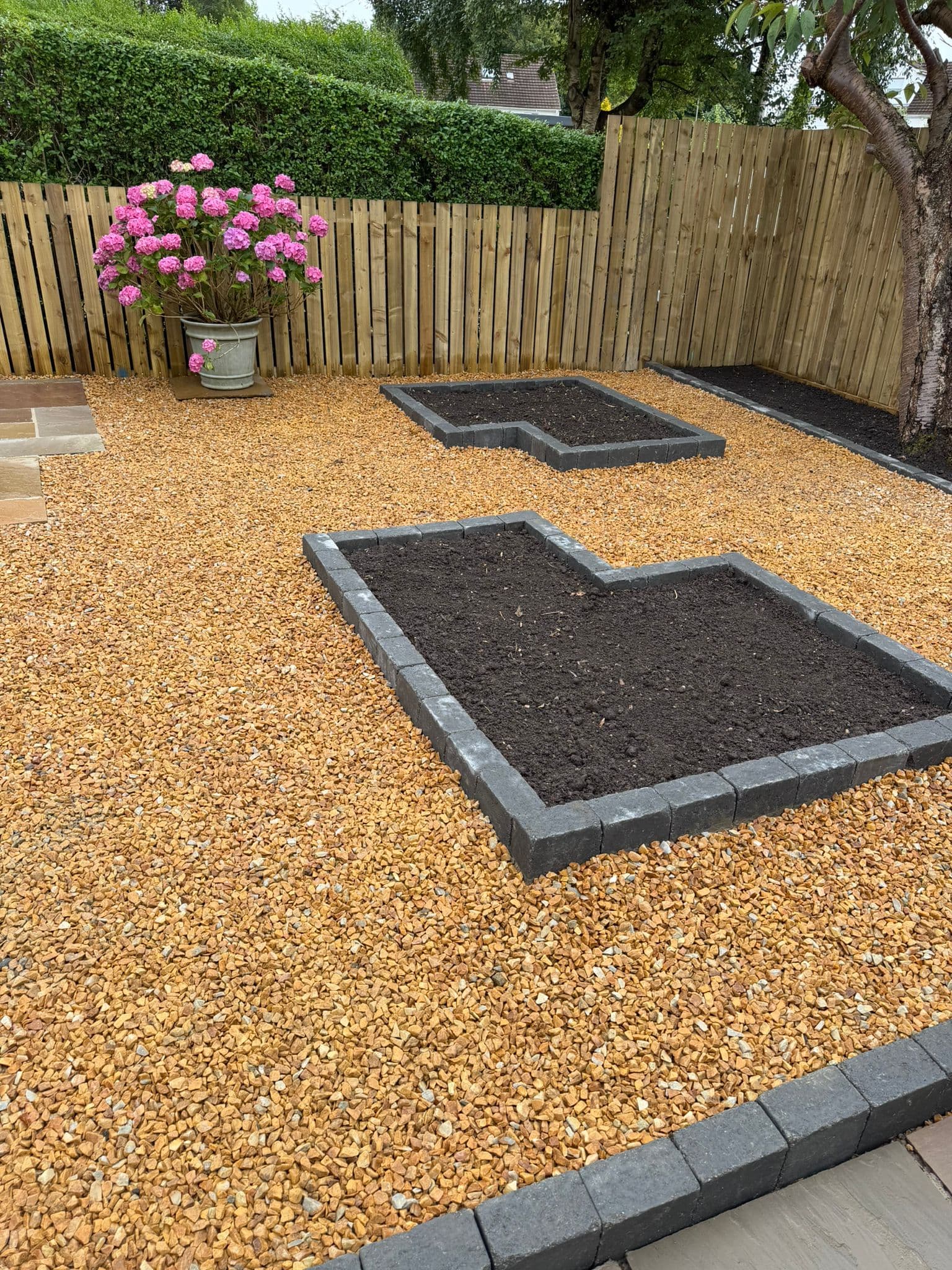
People ask for a low-maintenance garden for all sorts of reasons: work that takes them away, a house that is rented out, mobility that has changed, or simply no interest in spending weekends on it. It is an entirely reasonable brief. The difficulty is that several of the standard answers do not deliver, and one or two actively make things worse.
“Have not long moved into new house and needed to clear the garden and make it as low maintenance as possible due to new job taking me away on business all the time. Went away for a business trip and the garden was transformed on my return. No more moaning about cutting the grass in my house!”
What genuinely reduces the work
- Fewer, larger areas. Every separate bed, border and grass shape has an edge, and edges are where the time goes. One large bed is far less work than four small ones covering the same ground.
- Permanent edging. A hard edge between gravel, grass and planting is the single change that keeps a garden looking maintained between visits.
- Dense planting. Shrubs and ground cover planted to close up and cover the soil leave weeds nowhere to establish. Sparse planting in bare soil is a weeding job forever.
- Deep mulch. A good depth over the soil suppresses germination and holds moisture, so there is less weeding and less watering.
- Right plant, right place. Planting matched to the exposure and soil needs no intervention. Planting fighting its conditions needs constant attention.
What quietly creates work
Gravel laid straight onto soil with a membrane under it is the classic example. It looks immaculate for two years. Then organic matter blows in, breaks down on top of the membrane and forms a thin layer of compost across the whole surface, which is an ideal seed bed. Now you are weeding gravel, which is considerably worse than weeding soil because you cannot hoe it. Gravel done properly means a proper depth on a prepared, edged base, and accepting that it needs an occasional refresh.
Decking is another. It is quick to install and looks good, and in this climate it grows algae, needs cleaning to stay non-slip, and has a finite life. Paving costs more up front and asks for almost nothing afterwards.
Pots are the third. A collection of containers is the highest-maintenance thing in most gardens, because they need watering every day or two through summer. Planting in the ground does not.
Low maintenance does not have to mean hard surfaces
The version of this that people picture, a slabbed rectangle with nothing living in it, is low maintenance and also worse in every other respect. It drains badly, heats up, supports nothing, and looks like a car park. A mix of hard landscaping for the areas you use, gravel or rock landscaping where you want cover, and generous planting chosen for the conditions gives a garden with almost no upkeep that still behaves like a garden.
A common arrangement is a low-maintenance rebuild followed by two or three maintenance visits a year to keep the edges sharp and the planting in shape, which is a very different commitment to a fortnightly grass cut. If that is the direction you want to go, a visit and a free quote is the place to start.
Related services
Areas this applies to
Get a free quote
Tell us where you are and what the garden needs. Quotes are given after seeing the space, so the price reflects the actual job rather than a guess.
- Call
- 07766 636189
- Message on WhatsApp
- Opening hours
- Monday to Sunday, 8:00am – 4:00pm