
Landscaping
Sloping Gardens: What Actually Helps
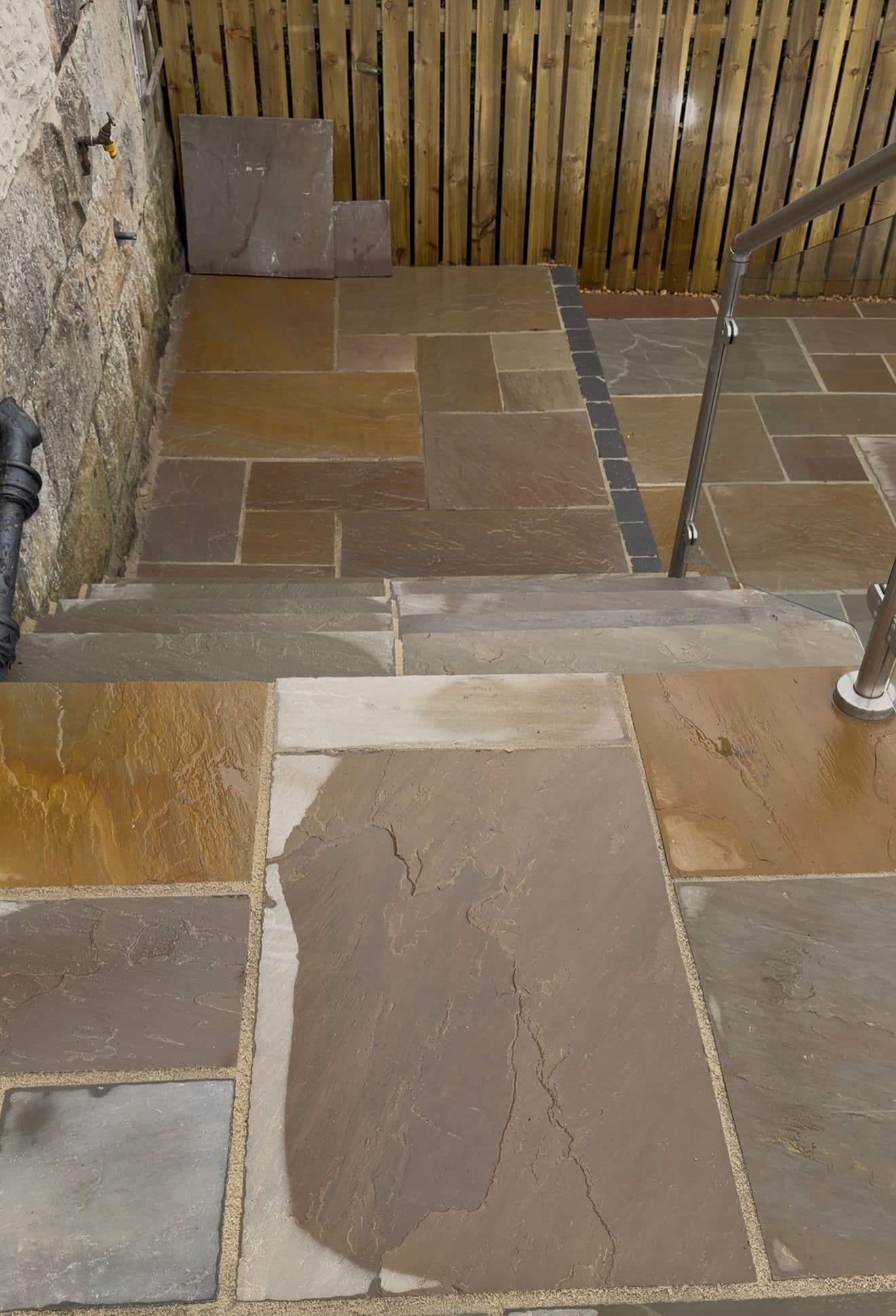
Plenty of gardens in this area climb away from the house rather than sitting level with it. Around Kilbowie and Radnor Park in Clydebank, up the hill from the river at Old Kilpatrick and Bowling, and on the older terraced streets across the west, a back garden can rise several metres over its length. That single fact changes what the space can be used for, what it costs to work on, and what will still be standing in ten years.
How slopes actually fail
A slope does not degrade evenly, it fails at specific points, and they are predictable.
- Water takes the fastest route down, cutting channels through beds and stripping topsoil into the lowest corner of the garden.
- Timber edging and stacked stone put in without foundations or drainage bulge, lean and eventually give way under saturated ground.
- Mowing a bank is genuinely hazardous, so it gets done less often, and the grass gradually turns into rough.
- Steps built to no consistent rise become the reason an older resident stops using the top half of their own garden.
The common thread is water and gravity working on something that was never engineered to resist them. Almost every long-term fix on a slope is about interrupting one or both.
Terracing: the honest cost and the honest benefit
Cutting one level terrace into a slope is the single change that transforms how a steep garden gets used. A garden that was previously only ever looked at through a window becomes somewhere to put a table, or somewhere children can actually play. It does not need to be the whole plot. One properly built flat area, sized for what you would realistically use it for, does more than a scheme spread thinly across the whole slope.
It is also the expensive option, and worth being straight about why. Terracing means cutting into the bank, holding back what is above with a retaining wall built on real foundations with drainage behind it, and dealing with the spoil that comes out. Access is usually the deciding factor on price: a garden reachable only through the house or a narrow close means everything moves by barrow, and that is time.
When levelling is not the right spend
Sometimes the better answer is to stop fighting the slope. Ground-cover planting with roots that genuinely bind soil, rock and gravel landscaping that does not wash out, and a set of well-built steps to get you up and down safely can make a bank into a feature for a fraction of what terracing costs. That is often the right recommendation on a garden where the slope is steady rather than severe, or where the budget is better spent on the flat part nearer the house.
Where a slope is causing water to arrive at the building, though, it stops being a garden question. Regrading so ground falls away from the house, and putting in the drainage to take that water somewhere sensible, comes before anything cosmetic.
“We recently had Scott and his team from Scotia Maintenance carry out work in my uncle’s back garden, including laying a brand-new patio and new slabbing. The finished work looks fantastic and has completely transformed the garden.”
Sloping ground takes longer to work than its square meterage suggests, and that is said up front rather than appearing partway through the job. It is one of the clearest examples of why quotes follow a visit instead of a phone call.
Related services
Areas this applies to
Get a free quote
Tell us where you are and what the garden needs. Quotes are given after seeing the space, so the price reflects the actual job rather than a guess.
- Call
- 07766 636189
- Message on WhatsApp
- Opening hours
- Monday to Sunday, 8:00am – 4:00pm